
Akamai Media LLC Web Performance Report

A clear look at
Desert Rose Bahá'í Institute's website.

A plain-English review of how drbi.org is working today: what a first-time visitor meets, how easily people find the Institute and its programs, and the changes I recommend.

Prepared for
Desert Rose Bahá'í Institute
Website
drbi.org
Site captured
October 27, 2026
Prepared by
Mark Moran
0/100
Opportunity

Overall website health

This is a modern, well-built site. It loads in under a second, the photography and type feel calm and considered, and the programs calendar is full, priced and bookable. The gaps are: a staff sign-in panel opens over the homepage for every new visitor, the testimonials section says on the page that its quotes are placeholders and the homepage title does not yet say what the Institute offers or where.

Strong Opportunity Needs attention

Your site at a glance

Beyond the homepage, here is how the whole site is put together. The site has a shallow structure. The sections that tell the Institute's story are Arts, History and Events.

39pages total36 content pages, 3 utility pages
2 levelsdeep at mostevery page is within two levels
8upcoming programs on the homepageNovember 2026 to February 2027
1988foundedstated in the site's structured data
How your pages are organized
Home1
Events & First Sunday Concerts2
Arts4
Agriculture2
History7
About, Facilities, Volunteer, Contribute4
Radio and Cemetery2
Contact1
News, Press, Newsletter, Topics (not in the menu)9
Content a visitor expects to find
✓About the Institute and its founder
✓Programs and classes, with dates
✓Prices and online booking
✓Contact details
✓Lodging on the grounds
✓News and updates
✕Real testimonials from past visitors
✕FAQ for first-time visitors
  • Every page is one or two clicks from the homepage, and the site publishes an XML sitemap that robots.txt points to.
  • The History section runs seven pages deep.
  • News, Press, Newsletter, Memories and Topics pages exist but are not linked from the main menu or footer.
  • The staff sign-in page at /login is open to search engines. It should be set to noindex to keep it out of search results.

Structure read from the site's XML sitemap on October 27, 2026.

Your nine-point scorecard

Every Akamai web performance report looks at the same nine areas: the things that decide whether a website earns trust, gets found, and turns visitors into participants. Each area is scored out of 100, and together they average to the overall score above. Click any card to read the full explanation of that area.

Does the site look current, trustworthy, and unmistakably yours? For an institute that invites people to travel to it, the website is often the first sense they get of the place.

Desert Rose Bahá'í Institute homepage, showing the sunset hero, three program pillars, an upcoming programs list, the founder video, lodging, testimonials and the newsletter signup
drbi.org homepage, captured October 27, 2026 at a standard laptop width.
What a first-time visitor meets
✓
A cohesive look: real photography of the grounds, a serif headline, a warm desert palette used consistently
1
A staff sign-in panel opens at the top right on a first visit, with a "Superadmin password" option visible to the public
2
The testimonials section states on the page that its quotes are placeholders
✓
A clear programs list with dates, venues and prices
Working

The design matches the place

The sunset video of the grounds, the restrained serif headings and the warm desert colors give the site a quiet, considered feel that fits a place of study. It reads as a current site, built recently and built with care.

Working

The founder is front and center

A video of Marguerite Sears explaining why Desert Rose exists sits in the middle of the homepage.

Gap

A sign-in panel opens on its own

On a first visit, a staff sign-in panel opens at the top right with an email field and a "Superadmin password" option. A visitor has no reason to sign in, so the panel reads as something left open, and it sits next to the Contribute button that the header is built around.

Gap

The testimonials are marked as placeholders

The section reads: "These are placeholder testimonials. Real voices from real visitors will replace them." The section also invites past visitors to write in.

Why this matters for your visitors

Closing the sign-in panel by default and replacing the placeholder quotes are the two changes for this area.

Can people find the Institute when they search for Bahá'í study, retreats, or concerts near Eloy and Phoenix? The technical setup is in good shape.

How much content Google has to work with
Your homepage
1,334 words
Sites that rank
~800 words
The homepage gives search engines more than enough to work with.
✓Meta description ✓XML sitemap ✓Canonical link ✓Section headings ✓Image descriptions ✕Descriptive page title ✕Sign-in page hidden from search
Working

The foundations are all in place

The homepage has one main headline, seven section headings, a meta description, a canonical link, and descriptions on 13 of its 15 images (the other two are correctly marked decorative). The site publishes an XML sitemap and robots.txt points to it.

Working

Real content, in quantity

At 1,334 words the homepage has more content than the ~800-word comparison, and the History, Arts and Agriculture sections add original writing.

Gap

The page title does not say what or where

The homepage title is Desert Rose Bahá'í Institute | drbi.org. It names the Institute but repeats the web address instead of saying what it offers and where, such as arts, agriculture and Bahá'í study in Eloy, Arizona. The title is the line people see in search results.

Gap

The staff sign-in page is open to search

The page at /login is marked for search engines to index. Setting it to noindex keeps it out of results.

Why this matters for your visitors

Someone searching for a Bahá'í retreat or a Sunday concert near Phoenix decides from the search result alone whether to click. A clearer title is a one-line change.

When someone asks ChatGPT or Google's AI "what's happening at Desert Rose this month?" or "where can I study the Bahá'í writings in Arizona?", can it find and recommend the Institute with confidence?

What an AI assistant can actually tell a visitor about you
Can read today
  • ✓It is an educational organization
  • ✓Address, phone and email
  • ✓Founded in 1988 by Marguerite Sears
  • ✓Each program as an event, with date, venue and price
Can't find, so won't recommend
  • ✕Answers to common first-visit questions
  • ✕Lodging on the grounds
Working

The Institute itself is clearly described

The site's structured data names it as an educational organization and includes the full street address, phone, email, founding year, founder, and social profiles.

Working

Every program is marked up as an event

Each program page labels itself as an event, with its date, venue and ticket offer, in the form Google's event listings and AI assistants read.

Gap

No question-and-answer content to quote

AI assistants answer questions like "do I need to be Bahá'í to attend?" or "can I stay overnight?" best when a site answers them directly. The site has no FAQ for them to draw on, and lodging is described only as links to Airbnb and Evolve.

Why this matters for your visitors

AI assistants and Google's event listings increasingly answer "what's on near me" before anyone visits a website. The Institute is already set up for that. A short FAQ gives those tools plain answers to the questions first-time visitors ask most.

Is it immediately clear what the Institute is, who it is for, and why someone should come? A first-time visitor decides quickly, and their questions are practical ones.

Questions a first-time visitor looks for: answered on the site?
4 of 6covered
✓What the Institute is and who it is for
✓What programs are coming up, and when
✓What a program costs
✓Where to stay
✕What past visitors say
✕What to expect on a first visit
Working

The purpose is stated plainly

"Study deeply. Grow food. Build a better world." followed by "open to anyone who believes the world can be transformed" tells a visitor what the Institute does and that they are welcome, in two lines. The three pillars, Scripture Study, The Arts and Agriculture, then make it concrete.

Working

The calendar answers the practical questions

Each upcoming program shows its date, venue, a short description and, where there is a fee, the price.

Gap

No real testimonials yet, and no FAQ

The four quotes in the testimonials section are labeled as placeholders. There is also no page for first-time visitors covering questions like whether they need to be Bahá'í to attend, what to bring, or how to get there. The homepage already says programs are open to Bahá'ís and non-Bahá'ís alike; an FAQ is the place to expand on that.

Gap

A small typo in the testimonials invitation

The line inviting past visitors to write in runs the email address into the word before it: "atinfo@drbi.org".

Why this matters for your visitors

People decide to make the trip when they can picture themselves there. The Institute's story and calendar already do most of that work. A handful of real quotes and a short FAQ answer the last questions a hesitant first-time visitor has.
Can a visitor get from landing on the site to reserving a place, giving, or signing up without friction? The paths are already there.

The path from landing to reserving a spot
Step 1 ✕
Lands on the homepage: a sign-in panel opens
Step 2 ✓
Sees upcoming programs with dates and prices
Step 3 ✓
Clicks "Reserve your spot" or "See details"
Step 4 ✓
Buys a ticket online through Humanitix
Working

Every goal has a clear button

Reserving a program, contributing, joining the newsletter, booking lodging, and making a gift each have their own clearly labeled button. The Contribute button sits in the header on every page.

Working

Contact details on every page

The footer carries the street address, phone and email on every page.

Gap

The first thing a visitor meets is a sign-in form

Before a visitor reaches the headline or any button, a sign-in panel asks for an email address. Some will assume they need an account to continue. It should open only when someone clicks the account icon.

Why this matters for your visitors

The paths that matter, booking and giving, are already short and clear.

Are the signals there that tell a first-time visitor the Institute is established and active? People look for proof before they travel somewhere new or give.

Trust signals a first-time visitor scans for
Secure connection (HTTPS)
Real street address and phone
Founder and history since 1988
Programs scheduled into 2027
Testimonials marked as placeholders
Working

The history is deep and visible

A seven-page History section, the founder's video, and a calendar running into February 2027 show an organization that is long established and active right now.

Gap

Placeholder testimonials read as no testimonials

A visitor who reads the note above the quotes learns that no real visitor has been quoted yet. Hiding the section until real quotes come in is one option.

Gap

The admin login is on public view

The sign-in panel that opens for every visitor includes a "Superadmin password" option. Keeping the panel closed by default addresses it.

Why this matters for your visitors

People travel to a retreat and give to an institution they trust. Taking down the placeholder quotes and the public admin option are the two changes for this area.

Can everyone use the site, including people with low vision, screen readers, or who navigate by keyboard? The site is close to the standard.

Automated accessibility scan: 8 issues, all one cause
8 serious (1 cause)
AAAAAA
Web accessibility grade
"AA" is the accessibility grade the law effectively expects an organization's website to meet. One color choice, the small year under each program date, keeps the homepage just below it.
Working

A clean scan apart from one color

Only one rule failed across the whole homepage. The page declares its language, sets a proper mobile viewport, uses headings in order, and describes its images.

Gap

The year on each date badge is slightly too faint

The small year (2026, 2027) under each program date is gray-brown on a cream background at a contrast of 4.41 to 1, just under the 4.5 to 1 the standard asks for. Darkening that one color slightly fixes all eight.

Why this matters for your visitors

Small, low-contrast text is harder to read for anyone with low vision. This is a single color change in one place.

Does the site work and look right on a phone? Most people looking up an event or directions do it from their phone.

On a phone
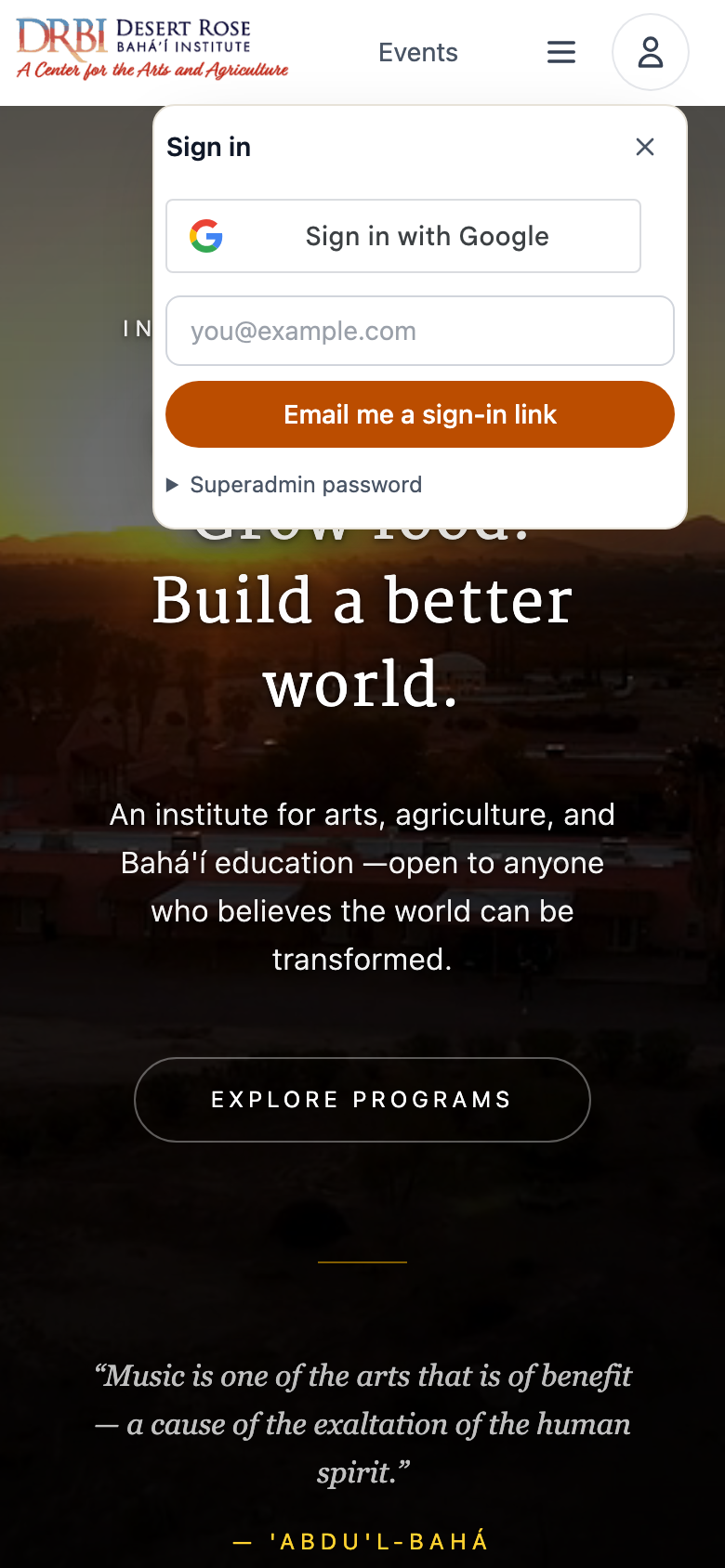
Desert Rose Bahá'í Institute homepage on a phone, with a sign-in panel covering the top of the headline
drbi.org on a phone-sized screen on a first visit, captured October 27, 2026.
✓
Fits the screen: proper viewport, collapsing menu, large readable headline
1
The sign-in panel covers the first line of the headline and the location line above it
Working

The layout adapts well

The menu collapses to a single button, the text sizes up for a small screen, and nothing scrolls sideways. Events stays visible in the header, which is the link a phone visitor most often wants.

Gap

The sign-in panel takes over the first screen

On a phone the sign-in panel spans most of the screen width and covers "Study deeply." and the location line. A visitor has to find and tap the small close button before they can read the page.

Why this matters for your visitors

On a phone there is no room to spare above the fold. With the panel closed by default, the first screen shows the place, the headline and the Explore Programs button.

Does the site load fast enough to keep people from leaving before it appears? Visitors start leaving after about three seconds.

80/100
Strong
0.8sFirst content appears
0.7sPage loaded
4.0MBDownloaded per visit
Working

Fast where it counts

The first content appears in about 0.8 seconds and the page is ready at about 0.7 seconds, measured on a fast connection. Images are served in modern formats at the right size, and the hero video has a lightweight still frame that shows while it loads.

Gap

Every visitor downloads the staff sign-in

Of the 304KB of JavaScript on the homepage, 270KB is Google's sign-in library, loaded for every visitor so the sign-in panel can offer "Sign in with Google". Loading it only when someone opens the panel would remove most of the page's script weight.

Gap

The hero video is most of the weight

The opening video is 2.2MB of the roughly 4MB a visit downloads. On a fast connection the video loads quickly. Serving a smaller version to phones would help visitors on cellular data in rural Arizona.

Why this matters for your visitors

The site is already fast. The two changes above keep it fast for visitors on slower phone connections.

If you do three things

The highest-impact fixes first

Ranked by impact for effort:

1

Keep the sign-in panel closed until someone asks for it

Open the sign-in panel only when the account icon is clicked, and load Google's sign-in script at that moment rather than on every page. One change clears the issue across design, conversion, trust, mobile and speed. Setting /login to noindex belongs in the same pass.

Effort: minimal · Impact: high
2

Replace or hide the placeholder testimonials

Collect three or four short quotes from past program participants, concert-goers or volunteers, and hide the section until they are in. Fix the "atinfo@drbi.org" typo at the same time.

Effort: minimal · Impact: high
3

Sharpen the homepage title and add a first-visit FAQ

Change the homepage title to say what the Institute offers and where, for example arts, agriculture and Bahá'í study in Eloy, Arizona. Then add a short FAQ covering who can attend, what to bring, lodging and directions.

Effort: minimal · Impact: medium

Want to talk through the findings?

This report walks through all nine areas of the website's performance. I'm glad to talk through the priorities for Desert Rose Bahá'í Institute.

Prepared by Mark Moran · Akamai Media LLC · akamai.media